
…Proposes Return to Regional Autonomy
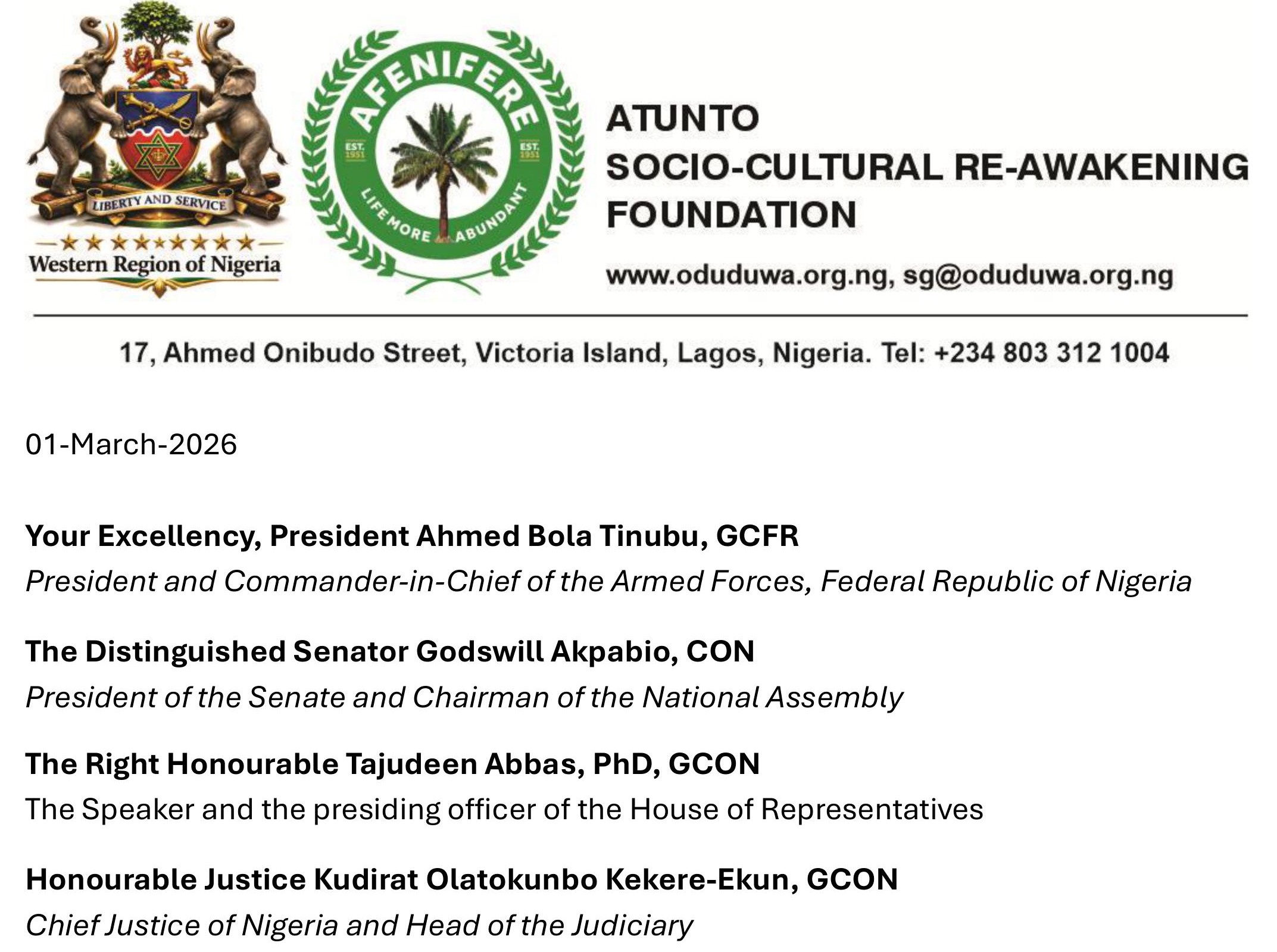
The Yoruba socio-cultural organisation, Afenifere, has formally petitioned the leadership of Nigeria’s executive, legislative, and judicial branches, calling for an urgent “valiant political decentralisation programme” to address systemic failures in the nation’s current governance structure.
In a letter dated March 1, 2026, the group argues that the extreme centralisation of power in Abuja has bred profound inefficiencies, stifled local initiative, and alienated citizens from the benefits of democracy.
The document stresses that replacing political personnel through periodic elections, such as those scheduled for 2027, will not resolve Nigeria’s “systemic ailments” unless the underlying constitutional architecture is reformed.
It described the current “unitary-style federalism” as an unsustainable administrative burden.
Afenifere points out that expecting a single leader to oversee nearly 50 ministers and approximately 1,000 federal agencies leads to bureaucratic bottlenecks and massive systemic waste.
This over-centralisation, the group contends, has disconnected the government from the governed, noting that less than 15% of voters participated in recent FCT Area Council elections as evidence of this alienation.
To “salvage the nation’s trajectory,” the group proposes a shift toward a ‘Decentralised Governance Framework,’ Which it said would allow Nigeria’s diverse ethnic nationalities to govern their own local affairs and drive development at their own pace.
A central component of the petition is the request for the Yoruba Ethnic Nationality of Western Nigeria to be granted the autonomy to govern itself within the Nigerian state.
Afenifere asked for a return to a regional governance model based on the 1954 Lyttleton Constitution, which they describe as a “golden era” of regional self-determination that fostered unprecedented milestones in education and infrastructure.
The group argues that restoring such autonomy, adapted for modern standards, would strengthen rather than threaten the Nigerian Federation.
Afenifere has requested that the following three critical actions be initiated within ‘45 days’:
Regional Constitutions: An amendment to the 1999 Constitution to explicitly permit ethnic nationalities or aggregates of contiguous states to draft and adopt their own subsidiary regional constitutions.
Devolution of Powers: A drastic reduction of the 68 items currently on the ‘Exclusive Legislative List’. The group proposes moving the bulk of these responsibilities to the regions to “unshackle local potential” and reduce the administrative load on the federal government.
Institutionalisation of Plebiscites: The constitutional recognition of referendums (plebiscites) to allow citizens to peacefully and democratically decide on their governance structures and public policy directions.
The petition includes a detailed “ANNEXE A” outlining how powers should be redistributed between the federal government and the regions. These include:
Federal Exclusive List: The central government would retain control over external defence (Army, Navy, Air Force), external affairs, immigration, currency, banking regulations, and the public debt of the federation.
Concurrent List: Several key areas would require the “expressed prior consent” of regional administrations, including **internal security and policing**, prison services, power and energy, and regional transportation (including railways).
Residual List: All powers not expressly delegated to the federal government would be exclusively reserved for the regions.
The letter, signed by leaders including Oba Oladipo Olaitan, Dr Akin Fagbohun and Chief Olusola Ebiseni, concludes with the expectation that the three arms of government will consult and provide a formal response to these proposals within 45 days.
The group indicates that other regional bodies, such as Ohanaeze Ndigbo and the Middle Belt Forum, are expected to follow suit with their own frameworks for self-governance.




Join the Conversation