

Chidimma Uchegbu -Abuja.
The Federal Government has reaffirmed its commitment to restoring lasting peace in Benue State through a comprehensive livestock development strategy designed to transform security challenges into sustainable economic opportunities.
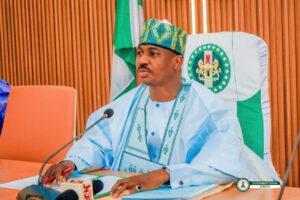
This commitment was reiterated by the Minister of Livestock Development, Idi Mukhtar Maiha, at the inauguration of the Benue State Commission for Peace and Reconciliation during the Benue Peace Summit held in Makurdi on Wednesday, 26th February 2026.
This was contained in the statement signed by the Assistant Chief Executive Officer ( Information), Ogochukwu Igboamalu.
Conveying the goodwill of President Bola Ahmed Tinubu, the Minister acknowledged the immense pain suffered by the people of Benue as a result of farmer-herder conflicts and related insecurity.
“We acknowledge the immense pain and loss that the people of Benue have endured. The farmer-herder conflicts and other forms of social instability have not only claimed lives and displaced communities, but have also cast a long shadow over the state’s vibrant agricultural landscape, threatening its identity as the ‘Food Basket of the Nation,’” he said.
The Minister further explained that conflicts arising from open grazing, cattle rustling, reprisals, and the breakdown of traditional conflict resolution systems require structural solutions anchored in economic collaboration.
“What we are preaching today is that part of the mission of this Peace Commission is to stabilise the countryside through practical mechanisms and frameworks that transform livestock into a vehicle for prosperity, not conflict.”
Mukhtar disclosed that over 13 livestock facilities across Benue State, many established over four decades ago, are currently in disrepair. He announced the Federal Government’s readiness to partner with the Benue State Government under a Public-Private Partnership model to rehabilitate and modernise these assets into functional Livestock Service Centres.
These include the Yandev Pig Progeny Centre, small ruminant ranches, abandoned abattoirs, pasture development areas, and other livestock production facilities.
Describing Benue as a “land of immense paradox” — blessed with fertile land yet burdened by conflict — the Minister said, “we have opportunities in the livestock sector today to absorb our youths through decent, well-paying jobs. From pig breeding to small ruminant fattening, from modern abattoirs to feedlot estates and pasture cultivation, the value chain is vast.”
In his address, the Governor of Benue State, Hyacinth Alia, represented by Deputy Governor Sam Ode, described the Benue State Strategic Plan for Peace and Reconciliation (2026–2030) as a homegrown roadmap developed through extensive consultations.
He stated that the vision is to build “a peaceful, secure, and stable Benue where communities coexist in harmony and conflicts are resolved through dialogue and justice,” anchored on strengthening early warning systems and conflict prevention mechanisms.
In his keynote address, the Country Director of CARE International, Hussaini Abdu, called for stronger prioritisation of Benue in national planning frameworks, while representatives of traditional institutions emphasised the urgent need for the safe return of internally displaced persons to their ancestral homes.
Goodwill messages were delivered by the International Organization for Migration, Caritas, and other partners, while the Director-General of the Benue State Commission for Peace and Reconciliation presented an overview of the State’s strategic framework.


Join the Conversation