
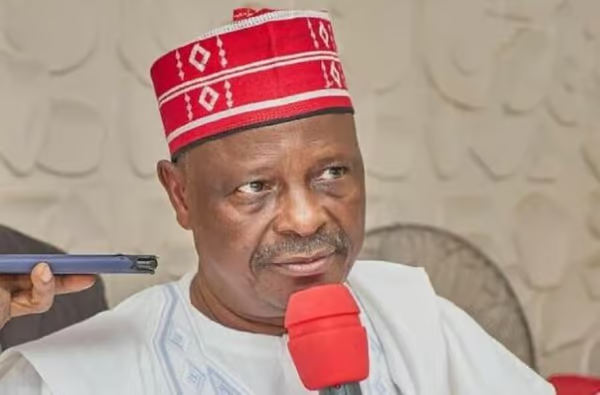
-Name Kwankwaso, Miyetti Allah leaders for Visa ban
A group of U.S. representatives, led by Mr Smith of New Jersey, has introduced H.R. 11, a significant legislative effort aimed at addressing systemic religious persecution and mass atrocities in Nigeria.
The bill, titled the “Nigeria Religious Freedom and Accountability Act of 2026,” seeks to mandate comprehensive reporting and increase diplomatic pressure on the Nigerian government to protect vulnerable populations, particularly Christian communities.
The legislation outlines a dire humanitarian situation, noting that systemic religious persecution has persisted in Nigeria since at least 2009.
Findings in the bill indicate that between 50,000 and 125,000 Christians have been martyred over the past 16 years, with more than 19,000 churches attacked or destroyed.
The bill specifically highlights the role of Fulani-ethnic militias, Boko Haram, and the Islamic State West Africa Province (ISWAP) in conducting massacres, kidnappings, and forced displacements.
Recent data, as captured in the bill, reveals that between May 2023 and May 2025, these militias killed more than 9,500 people, predominantly Christians, during high-profile attacks such as the Christmas Eve and Easter massacres of 2023, 2024, and 2025.
It noted that currently, between 3.5million to 5 million Nigerians remain internally displaced due to the ongoing violence.
A central issue identified in the bill is the Nigerian government’s routine denial that religious persecution exists and its failure to intervene even when provided with early warning notifications of impending attacks.
Furthermore, the legislation criticises the enforcement of blasphemy laws in 12 northern states, which carry the death penalty and have been used to target religious minorities and dissenters.
The bill cites the case of Sunday Jackson, a Christian farmer who spent a decade in prison and faced a death sentence for defending himself against an armed attacker, as an example of the legal challenges facing victims.
While Jackson was pardoned in late 2025, the bill notes that many perpetrators of violence against Christians face no punishment.
The legislation references several key actions already taken by the United States to protect Christians in Nigeria, which include Country of Particular Concern designation. It noted that in 2020 and again in October 2025, President Donald J. Trump designated Nigeria as a Country of Particular Concern (CPC) under the International Religious Freedom Act of 1998, adding that the US had also applied Legislative Pressure through the Fiscal Year 2026 National Security Appropriations Bill, which included provisions to condition foreign assistance to Nigeria on efforts to protect innocent lives.
If passed, the bill would require the Secretary of State to submit a comprehensive annual report to Congress detailing Nigeria’s compliance with religious freedom standards.
The proposed future actions contained in the bill include visa bans and asset freezes under the Global Magnitsky Act for individuals and entities responsible for violations. It specifically named former Kano State Governor Rabiu Musa Kwankwaso, the Miyetti Allah Cattle Breeders Association of Nigeria (MACBAN), and Miyetti Allah Kautal Hore.
The bill wil also mandate the Secretary of State to determine if certain Fulani-ethnic militias qualify as Foreign Terrorist Organizations (FTOs), as well as pressure Nigeria to repeal blasphemy laws and release prisoners detained for their faith.
The bill highlights the need to address illegal Chinese mining operations that reportedly pay protection money to militias, further destabilising the region.
It concludes that a future positive relationship between the U.S. and Nigeria hinges on the Nigerian government’s willingness to combat the persecution of Christians and end the culture of impunity for extremist actors.

Join the Conversation