
By Danjuma Musa
Some of the reflections in this piece draw inspiration from the thoughts originally shared by an unknown writer whose lines captured the mood of the moment. His words echoed the national unease, and it is only fair to acknowledge that resonance.
Imagine, for a moment, that Governor Babagana Zulum of Borno State visited Hussaini Ismaila, an imprisoned ISWAP commander whose name is etched into the memory of Nigerians for committing one of the most heinous terror attacks in recent history of Nigeria. If, for any reason, Zulum had walked into that prison, the reaction would have been instant and explosive. He would have been dragged across every media platform, condemned on radio and television talk shows, and tried in the court of public opinion long before anyone asked a clarifying question. His motives would have been twisted, his integrity questioned, and his respected leadership declared suspect. At the end of the day, self-appointed patriots would have demanded his immediate resignation.
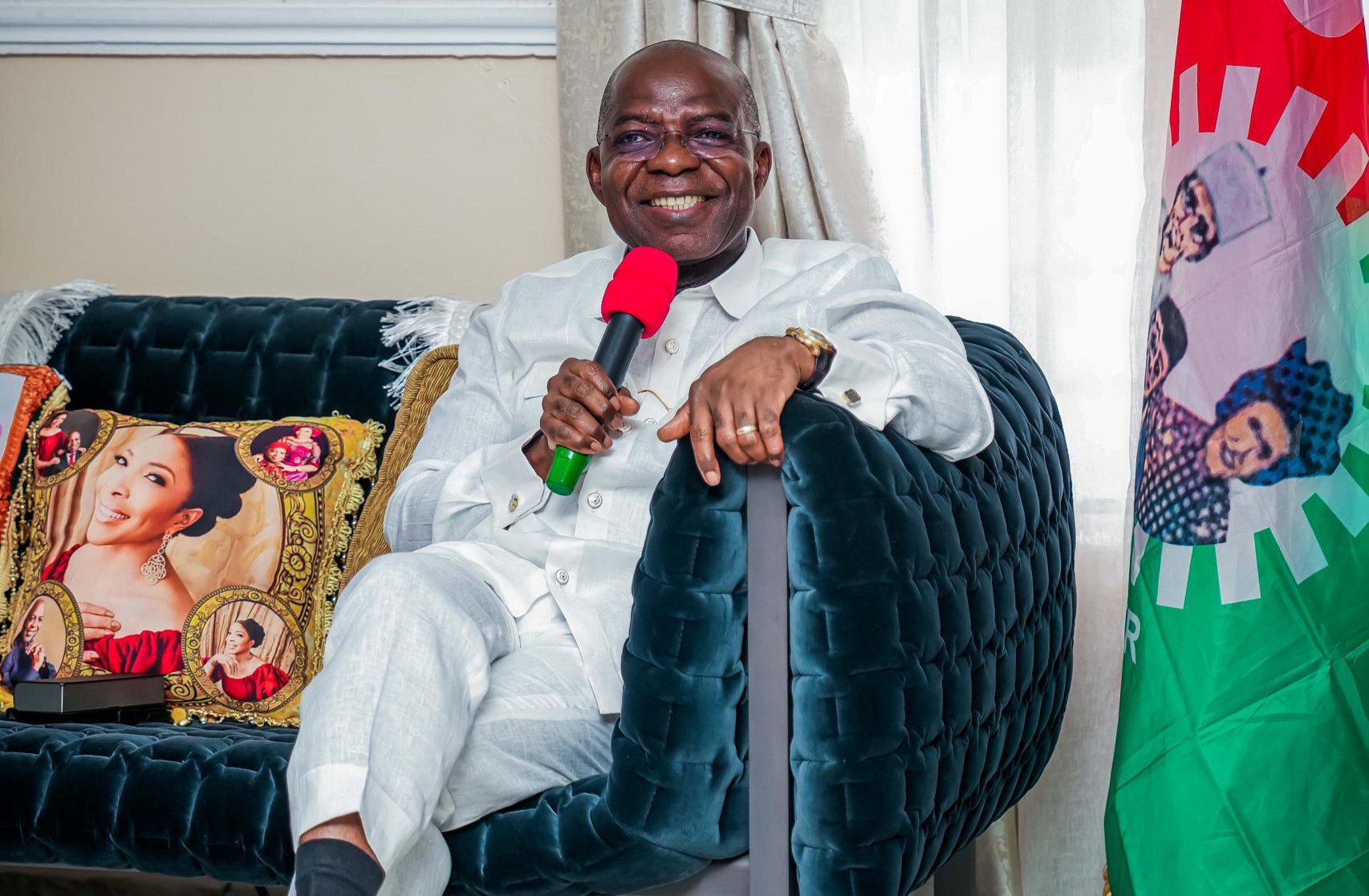
Now contrast this with what has actually happened: Governor Alex Otti of Abia State’s visit to Nnamdi Kanu, a man a man that has been convicted of terrorism and serving a life sentence for treasonable offenses at the Correctional Center Sokoto. The country barely stirred. There was no uproar, no screaming headlines, no prime-time debates, and no trending hashtags. It was eerily calm, as though the visit were routine, like the governor inspecting a road project or commissioning a school block. The visit was even wrapped in elegant justifications: “dialogue,” “compassion,” and “statesmanship.” Governor Otti went as far as thanking the Sokoto State Government for “taking good care of their son,” even though the government had absolutely nothing to do with his care and incarceration. These are very tender words for a man serving a life sentence for terror-related offenses.
The disparity between what the reaction would have been and what it actually is speaks to Nigeria’s fractured relationship. It exposes the uneasy and often dishonest dynamic between the largely Muslim North and the largely Christian South. It reveals a country that, despite 65 years of independence, still struggles to see itself as a single nation bound by a shared moral compass.
Had Governor Zulum visited Hussaini Ismaila or any other notorious Northern-born terrorist, the outrage would have instantly morphed into a national morality play of “the North protecting its own,” “Northern leaders enabling extremism,” and “the usual Northern double standard.” One man’s action would be weaponized against the entire region.
Yet Governor Alex Otti’s visit to the convicted Nnamdi Kanu produced almost the opposite reaction. Many in the South continue to view Kanu not as a criminal but as a hero of regional grievances and political frustration, despite the monumental crisis he has unleashed on the South-East, including the deaths of Professors Akunyili and George Obiozor, two erudite scholars, and many others for daring to oppose his ill-informed Biafra agitation. Though there are strident efforts to cast Otti’s visit as an act of political healing, the fact remains that it was an ill-advised gesture, which many can rightly interpret as an endorsement of Kanu’s actions.
The same gesture, but filtered through two completely different regional lenses.
The North has every reason to be scandalized by the lack of reaction. Those who question its reaction are either dishonest or mischievously forgetful. The North’s anger is not merely emotional; it is historical. It is built on decades of being held to a different standard, and not double standards. Northern leaders have lived for years under the suspicion of being accomplices to the campaign of terrorism. Every statement, policy, or gesture has been thoroughly examined for hidden meanings. A wrong meeting becomes a screaming headline; a wrong photograph becomes an evidence of sponsorship. A single misstep is enough to trigger allegations of complicity with terrorists. The North has lived under this microscope for decades.
This shifting morality is at the core of the North’s grievance: if terrorism is a national offense, it should attract a national reaction and not selective outrage or region-specific empathy. Nigeria cannot defeat extremism while applying different ethical standards, like our varied cultural fabrics;an ankara here, an aso-oke there, and an agbada elsewhere. Terrorism would definitely become harder to fight when one region embraces its militants with euphemisms while condemning others with megaphones. This inconsistency will continue to fracture the country along moral fault lines and gives the extremists the room to exploit. It will also weaken our security institutions, our diplomacy, and our national cohesion.
At the heart of Nigeria’s fundamental fracture is the fact that identical actions provoke different reactions depending solely on who carries them out and where they come from. We judge actions by geography, ethnicity, and religion and not by principle. Had Zulum visited a convicted terrorist, a national chorus would have risen: “The North is enabling terrorism!” “This is why insecurity persists!” “Proof of collaboration!” One handshake would have become evidence of conspiracy; one photograph, proof of treason.
A nation cannot be built when identical actions carry different meanings for different regions. It cannot heal when suspicion is the default interpretation. It cannot unify when empathy is reserved for “our own” and condemnation is unleashed on “the other.”
Nigeria has never shared a unified moral compass. We do not have a common definition of treason or a shared understanding of what constitutes an enemy of the state. We condemn in Hausa what we excuse in Igbo; justify in Yoruba what we criticize in Tiv; and rationalize in the Niger Delta what we punish in the North-East. Our reactions are shaped not by national values but by regional sympathies and long-standing grievances.
Sixty-five years after independence, Nigeria remains a large, complex country, but not yet a nation. Until we confront this imbalance, this deep-seated regional asymmetry in how we interpret events, judge leaders, and unfairly assign blame, nationhood will continue to elude us. The disparity is more than a political issue; it is a mirror. It reflects why, after all these decades, Nigeria still searches for the glue that would bind us into a nation.
If Nigeria desires peace, stability, and progress, it must do what it has avoided for decades;embrace and enforce a single, unwavering moral standard for all citizens and leaders. The North knows this intimately; it has lived with the consequences of selective outrage. The truth is simple, we cannot build a nation with two ethics. We cannot defeat extremism with regional empathy. We cannot become one country while practising two moralities.
Where the rest of the world sees terrorism as a crime, Nigeria allows it to shapeshift depending on who is involved. One extremist becomes a butcher; another becomes a misunderstood agitator. The bombing of a school in the North is barbaric, while in the South it is framed as resistance. The same law that condemns treason in one region suddenly becomes negotiable in another.
Let this moment of Governor Otti’s visit be a reckoning, and not a passing phase. The real danger is not Otti’s visit; it is the environment that allows similar actions to carry different meanings depending solely on regional identity. When identical gestures provoke opposite reactions, there is no stable national foundation to stand on.


Join the Conversation